Best Heatless Hairstyles for Black Hair: 8 Styles Compared

The best heatless hairstyles for Black hair are two-strand twists, Bantu knots, braid-outs, banding, pin curls, flat twists, cornrows and a well-set wash-and-go. Which one wins depends on your texture, your length, and how much time you have the night before. Below, I compare them side by side, show you how to set and take them down without breakage, and explain how to preview a look before you commit your hair to it.
I have sat in the chair for the long twist session, and I have also stood in the mirror at 7 a.m. wishing I had picked a different style. Heat was never the only problem. Guessing was.
TL;DR
- Two-strand twists and Bantu knots are the most reliable heatless curl methods for coily textures (3A to 4C). Smaller sections give tighter curls.
- Braid-outs and banding stretch hair without direct heat. Cornrows and flat twists double as low-manipulation protective styles.
- Set on damp hair, not soaking, and let everything dry fully before you take it down.
- Tension is the real risk. Even dull pain means the style is too tight.
- Preview a style on your own photo first, so you know it suits your face and texture before you spend hours on it.
Table of Contents
- Why go heatless in the first place
- How I compared these styles
- The comparison at a glance
- Two-strand twist-outs
- Bantu knots and Bantu knot-outs
- Braid-outs
- Banding
- Pin curls
- Flat twists and cornrows
- The wash-and-go
- Setting, drying and takedown without breakage
- Heatless styles for kids and for transitioning hair
- How to choose your style
- Preview before you part
- Our perspective
- FAQ
- Sources
Why go heatless in the first place
Heat changes hair. Research on Afro-textured hair describes how thermal styling temporarily disrupts hydrogen bonds and can leave irreversible bond weakness, which shows up as a looser curl pattern. If you have ever pressed your hair once and watched a section never quite return, you know what that looks like.
Heatless does not mean harmless, though. Rough handling of wet hair, or any style that pulls at the scalp, can still cause breakage and thinning. So the goal here is gentle, low-tension styling, not just no hot tools.
How I compared these styles
I looked at five things that matter on a real week:
- Best textures: which curl patterns it flatters.
- Setup time: what you do on wash day or the night before.
- Hold: how long the look lasts.
- Tension risk: how easy it is to pull too hard.
- Best for: the person who will love it most.
The comparison at a glance
| Style | Best textures | Setup | Typical hold | Tension risk | Best for |
|---|---|---|---|---|---|
| Two-strand twist-out | 3A to 4C | 30 to 90 minutes, overnight dry | Several days | Low | Defined, stretched curls |
| Bantu knot-out | 3B to 4C | 30 to 60 minutes, overnight dry | Several days | Low to medium | Springy, tight curls |
| Braid-out | 3C to 4C | 45 to 90 minutes | Several days | Low to medium | Crimped, voluminous waves |
| Banding | 4A to 4C | 20 to 40 minutes | One wash cycle | Medium | Stretching without heat |
| Pin curls | 3B to 4C, short or relaxed | 30 to 60 minutes | One to three days | Low | Vintage waves, short hair |
| Flat twists | All textures | 45 to 120 minutes | One to two weeks | Medium | Neat, low-manipulation looks |
| Cornrows | All textures | 1 to 4 hours | One to three weeks | Medium to high | Protective, athletic, sleek |
| Wash-and-go | 3A to 4C | 30 to 60 minutes plus drying | A few days | Low | Natural definition |
The times and hold are ranges from my own experience with these styles, so treat them as a starting point. Your density and length will shift them.
Two-strand twist-outs
If I could only teach one heatless method, this would be it. Sebastian Professional artist Angel Cardona prefers two-strand twists for 3A to 4C textures because they lock in moisture and enhance natural curl definition.
How to do it well:
- Start on clean, damp hair, not soaking.
- Part into small, even sections before you apply product. Skipping this step is the quickest way to uneven results, as stylist Ciceron warns for wash-and-go prep.
- Layer leave-in, cream, then gel or custard.
- Twist from root to tip and let it dry completely.
- Unravel with oil or butter on your fingers, not a brush.
Smaller twists give you tighter, more defined curls. Larger twists give you looser, softer waves. Choose based on the mood you want, not just the clock.
Bantu knots and Bantu knot-outs
Bantu knots are the classic for springy, defined curls. Heatless curls can be set on damp hair with twists and pins or Bantu knots, and the rule is the same as with twists: smaller sections, tighter curls.
The one thing people rush is drying. Knots that are even slightly damp at the center will frizz when you open them. Give them a full night, and tie a satin scarf over the top.
The knots themselves are also a style. Worn in, they look sculptural and clean on shorter lengths. If you want inspiration on how many ways they can look, our guide to Bantu knot styles walks through twelve looks and care tips.

Braid-outs
Braid-outs sit between twist-outs and a crimped wave. Loose braids can stretch curls and coils without direct heat, as long as you use soft ties and gentle tension. Five or six large braids give you a loose wave. Ten or more small braids give you a tighter, fuller crimp.
A useful habit from stylists: finish wash day with 8 to 12 plaits or twists so hair dries organized and detangled, which cuts down on daily manipulation. Then you can leave them in as a style, or open them up for a braid-out later in the week.
Banding
Banding uses soft elastic bands along sections of hair to stretch it as it dries. It is the go-to when you want length and volume without any hot tool. It also asks the most care from you: use soft, snag-free bands, avoid pulling at the roots, and never leave them in so tight that your scalp tingles or aches.
Banding works best on hair that is well moisturized. Dry, brittle hair does not like being stretched.
Pin curls
Pin curls are an underrated option for short hair. According to HairstyleCamp’s coverage of pin curl styles for short Black hair, on natural 3B to 4C textures they boost definition, and on relaxed or stretched hair they create vintage waves. Either way, work on damp, not soaking, hair and layer leave-in, cream and gel.

If you are growing out a cut, pin curls are one of the few styles that look intentional at almost any length. Our guide to short natural hairstyles pairs well with this one.
Flat twists and cornrows
These two earn their place because they work as both a look and a protective style. Popular protective options include single or knotless braids, cornrows, two-strand twists, French twists, ponytails, wigs, sew-ins and locs. Styles like cornrows, twists and sew-ins protect hair from environmental stressors, and minimizing manipulation reduces friction and breakage, which helps natural hair keep its length.
Flat twists are gentler to do and easier to redo. Cornrows last longer but ask for a careful stylist and a firm “that’s too tight” from you.
Protective styling works best on a healthy foundation, and a solid routine matters as much as the style itself. This step by step natural hair care guide covers the basics that make low-manipulation styles last. For more options, see our rundown of protective hairstyles for Black hair and the breakdown of braids versus twists.
One caution from Allure: if your hair is fragile or already damaged, focus on healthy growth first rather than going straight into a long-term protective style.
The wash-and-go
The wash-and-go is the simplest heatless style and the easiest to get wrong. Apply your gel, mousse or custard with praying hands or rake-and-shake so product is distributed evenly, and let your hair dry completely before you fluff. A hooded dryer or a cool-setting diffuser helps you dry without frizz.
Time expectations: a heatless set takes about 10 to 20 minutes of work plus 6 to 8 hours overnight, and curls typically hold through the day and often into a second day, with satin sleep protection helping them last, according to Essence.
Setting, drying and takedown without breakage
This is where most heatless styles are won or lost.
- Damp, not dripping. For robe-tie or ribbon sets, hair should be about 80 to 90 percent dry. Soaking-wet hair tends to drop before the shape holds.
- Mind tension. Even dull pain is a sign a style is too tight. Take it out or loosen it.
- Take down gently. Improper takedown causes as much damage as a tight install. Use oil or conditioner, finger detangle, and skip the brush while hair is dry and fragile.
- Don’t brush curls hard. Curls are fragile because of their spiral structure, and brushing causes breakage from pressure.
- Wash regularly. Weekly gentle cleansing can help regulate the scalp and reduce buildup and breakage, despite the old belief that frequent washing always means dryness.
- Fewer sections if you’re fragile. Use fewer sections and gentle fasteners to reduce handling.
If you wear locs, tension management matters even more. Our locs maintenance guide covers how to prevent traction alopecia.
Heatless styles for kids and for transitioning hair
For children, the same logic applies in a softer form: loose twists, large braids and flat twists, with soft ties and no pulling at the edges. Kids’ hair is often finer and edges are delicate, so go bigger on sections and shorter on wear time. If your child complains, listen the first time. A pediatrician or a stylist experienced with textured hair can advise on scalp concerns.
If you are transitioning or in the middle of a big chop, the challenge is two textures on one head. Twist-outs, braid-outs and flat twists blend the line well, because they stretch and define both textures together. We put together a guide to transitioning hairstyles for natural hair growth if you want a longer list.
How to choose your style
Ask yourself three questions.
- How long will it need to last? One night out means a twist-out or Bantu knot-out. Two weeks means flat twists or cornrows.
- How does my scalp feel? Tender scalp means fewer, looser sections and skip banding.
- Will I like it on me? This is the one people skip.
That last question is why I care about preview tools. A style that looks incredible on a creator with a different face shape, hairline or density can look completely different on you. Hours of setting are a lot to spend on a guess.
Preview before you part
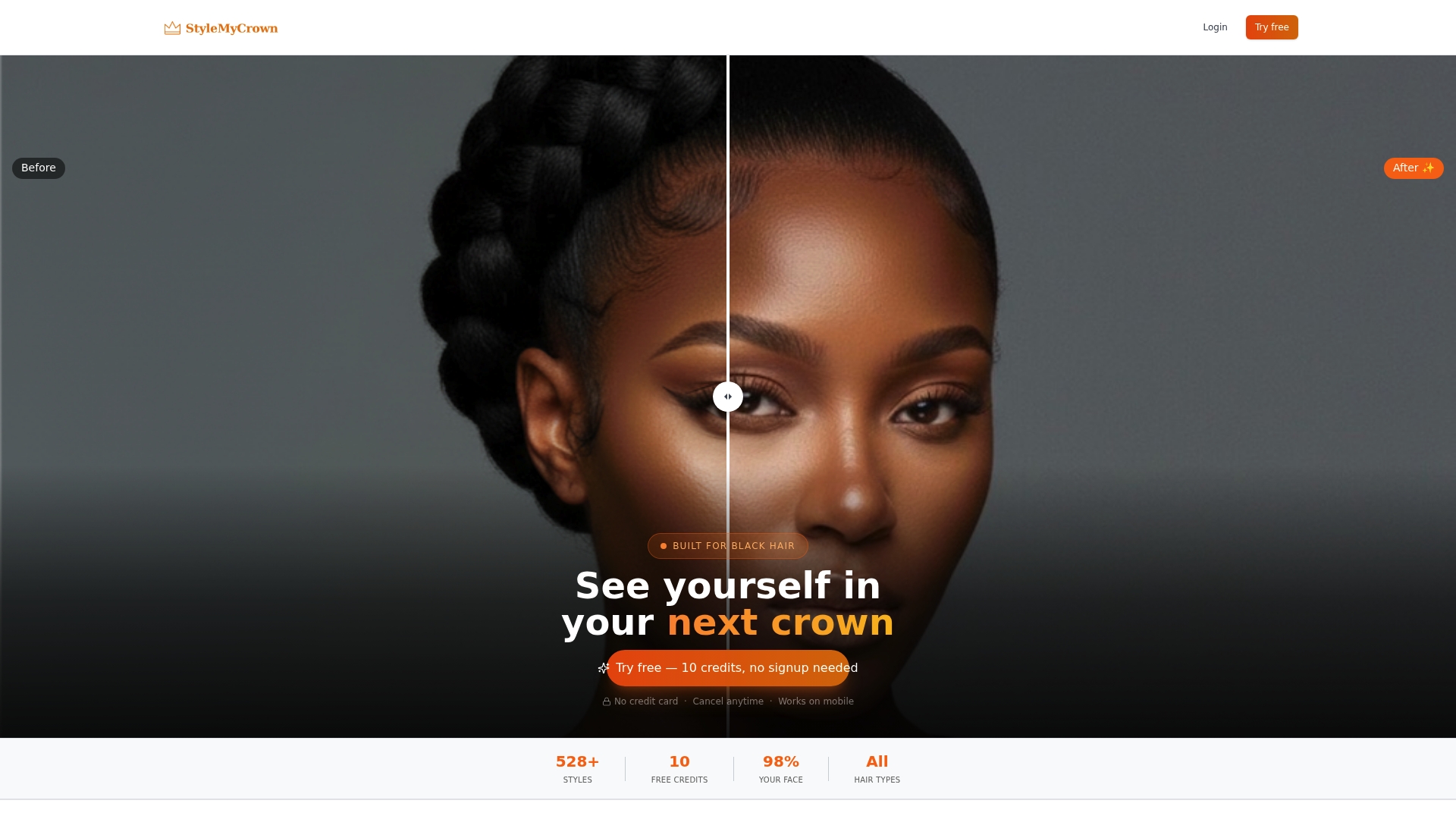
This is what Stylemycrown was built for. It is a virtual try-on made for Black and textured hair that uses augmented reality to show you styles on your own photo. The catalog includes over 528 styles curated for different textures and types, so you can compare a short twist look, a braided look and a curl-defined look without sectioning a single strand.
Your face data is processed securely, and it is never retained or used for AI training.
Start free. You get 2 complimentary credits to try styles with no commitment. After that, the 1 Week Trial is $17.48 per week and the 4 Week Plan is $38.73 per 4 weeks. A 12 Week Plan is also listed on the pricing page. Or head straight to the virtual try-on for Black hair and test your first look.
If braids are on your list, preview knotless braid styles or scalp-safe box braids first. For gentler edges, try the boho braid styles.
Our perspective
I have worn almost every style on this list. I have also sat through hours of installs for looks that did not feel like me once I saw them in the mirror.
That is the part nobody talks about. Heatless styling is gentler on hair, but the real cost is time and hope. You invest a whole evening, sleep in the set, and wake up wondering if it worked.
We built Stylemycrown so that moment comes earlier. When you can see a style on your own face first, across over 528 options made for Black and textured hair, you stop choosing from photos of other people. You choose from what looks like you.
Our approach is simple. Pick the heatless method that fits your texture, preview the look, then set it with care. Confidence is part of hair health too.
Christelle
FAQ
What is the easiest heatless hairstyle for Black hair?
The wash-and-go and the two-strand twist-out are the easiest places to start. Both use damp hair, product and patience rather than technique. Part your hair into even sections, apply product evenly, and let it dry fully before you touch it.
How long do heatless curls last on natural hair?
Often through the day and sometimes into a second day, especially if you protect them with satin at night. Tighter sets from smaller sections tend to hold better. Hair that was set too wet may drop sooner.
Are heatless styles always safe for my hair?
No. Heatless styling does not guarantee damage-free hair, because rough handling of wet hair or tight styles can lead to breakage and traction alopecia. Keep tension low, and if you notice thinning or scalp pain, see a dermatologist or a trichologist.
Can I do heatless styles on short hair?
Yes. Pin curls, small twists, flat twists and short Bantu knots all work on shorter lengths. Smaller sections give more definition, and a preview helps you check that the look suits your length.
How can I see a heatless style on me before trying it?
Use a virtual try-on built for textured hair. Stylemycrown lets you preview styles on your own photo, and you start with 2 complimentary credits.
Sources
- Heatless Curl Hacks For All Hair Types, Bustle
- Afro-textured hair care: a narrative review, PMC
- Your Complete Guide to Protective Styles for Natural Hair, Allure
- The Ultimate Wash N’ Go Guide For 4C Hair, Essence
- 7 Stylist-Approved Tips for the Lazy Natural, Allure
- How to Help Natural Hair Retain Length, The Strategist
- Heatless Pin Curl Styles for Short Black Hair, HairstyleCamp
- How to Get Heatless Curls Overnight, HairAide


