Best Interview Hairstyles for Black Hair, Natural and Styled

The best interview hairstyle is the one that looks clean, stays in place and feels like you. For Black and textured hair, that usually means a sleek low bun, a defined twist-out or wash-and-go, neat flat twists, a polished puff, or braids with crisp parts and smooth edges. Below, I compare the options by prep time, upkeep and workplace fit, so you can choose with a plan instead of a guess.
TL;DR
- Pick a style you already know how to do. Interview morning is a bad time to test something new.
- Use the 3C check: clean, controlled, comfortable. If your style passes all three, it is interview-ready.
- Braids, twists and locs are fine when parts are neat and edges are smooth. Install or retwist at least four days ahead.
- Match your choice to the industry. Finance and law lean conservative, creative and tech fields allow more range.
- Preview two or three finalists on your own photo before you commit. Our try-on gives you 2 free credits to do it.
Table of Contents
- Why this question feels heavier for Black hair
- The 3C check for any interview style
- The best interview hairstyles compared
- Styles that need the least morning effort
- Styles that reward a little planning
- Choosing by role and industry
- Interview hairstyles for men and boys
- Thinning edges and sensitive scalps
- A simple timeline before the interview
- Preview your options before you commit
- Our perspective
- Common mistakes to avoid
- FAQ
- Sources
Why this question feels heavier for Black hair
Most interview hair advice is written for straight hair. “Keep it neat” sounds simple until your hair has a texture, a routine and a history that the advice never considered.
I remember standing in front of the mirror the night before an important meeting, holding two options in my head. One felt safe. One felt like me. That tug is real, and it is not in your imagination.
Research backs it up. Across four studies, Black women with natural hairstyles were rated as less professional and less competent than Black women with straightened hairstyles, and less likely to be recommended for an interview. The effect was stronger in industries with strong dress norms.
The law has started to respond. California passed the first CROWN Act in 2019, and 27 states had passed similar legislation as of December 2025, though there is no federal equivalent. Protection depends on where you live, so check your own state.
None of this means you must change your hair. It means you can walk in prepared, with a style you chose on purpose.

The 3C check for any interview style
One simple framework cuts through the noise. The 3C Rule asks whether your hair is clean, controlled and comfortable.
- Clean: freshly washed and conditioned, with a moisturized, healthy look. Wash and condition the day before.
- Controlled: no loose pieces pulling your attention, edges laid, parts neat.
- Comfortable: you are not tugging, touching or adjusting it for an hour. A tight style that hurts will show on your face.
Professional standards across grooming guidance for interviews keep returning to the same idea: hair should look well maintained and intentionally styled. Intentional is the key word. A puff that is shaped and moisturized reads as a decision. A puff you rushed reads as an accident.
The best interview hairstyles compared
Here is how the strongest options stack up. Prep times are my own practical estimates from styling experience, so adjust for your hair.
| Style | Best for | Prep | Upkeep risk | Industry fit |
|---|---|---|---|---|
| Sleek low bun | Medium to long hair, stretched or pressed hair | 20 to 30 minutes | Low | Conservative to creative |
| Twist-out | Natural hair of most lengths | Set the night before | Medium (humidity, frizz) | Most, polished version for corporate |
| Defined wash-and-go | Curls and coils with a routine you trust | 45 to 90 minutes with drying | Medium | Most |
| Flat twists into a bun or updo | Short to medium hair | 30 to 60 minutes | Low | Conservative to creative |
| Low or high puff | Medium to long natural hair | 15 to 20 minutes | Low | Creative, tech, many corporate |
| Neat braids or cornrows | Anyone wanting low morning effort | Install days ahead | Low | Most |
| Locs styled up or back | Locs of any length | 15 to 30 minutes | Low | Most |
| Silk press | Hair you want smooth and swingy | Salon visit, a day or two ahead | Medium (moisture, humidity) | Conservative to creative |
| Tapered or faded cut with a clean top | Short natural hair, often men | Barber visit, a few days ahead | Low | Conservative to creative |
The options themselves are not a secret. A recruiter-sourced list in Black Beauty Magazine names a side bun, top knot, braided bun, coiled TWA, palm coils, flat twists into a bun and a stretched updo as safe options. Hair.com adds Marley twists, crown braids, cornrows, box braids and silk presses when they are neat and suited to the wearer. The real work is choosing among them.
Styles that need the least morning effort
If you are nervous, remove variables.
Neat braids, twists and cornrows
Protective styles are a gift on interview week because the work is already done. Clean parts, smooth edges and a tidy length are what make them read as professional. Guidance on protective styles for interviews says braids and twists work when they are clean and well groomed, and that a low bun or low ponytail keeps longer lengths secure.
Timing matters. Install or retwist braids or locs at least four days ahead so the parts settle and your scalp calms down. A fresh install the morning of can leave tight, irritated edges and a sore head.
If you wear box braids, our guide to scalp-safe box braid styles helps you pick a size and length that looks polished and does not pull. For a comparison of how long each lasts, see braids versus twists.
Locs styled up or back
Locs pulled into a low bun, pinned updo or neat half-up look composed and deliberate. If your retwist is due, book it before the interview, not after. Our post on retwist styles for locs shows how different patterns look on a photo.
The low or high puff
A puff is quick and clean when the shape is even and the edges are smoothed. Brush the front with a soft brush and a light gel. Go easy, because heavy gel can turn white and flaky under office lighting and on camera.
Styles that reward a little planning
Twist-outs and wash-and-gos
These show off your texture, which is exactly the point. They also depend on drying time and humidity. A twist-out needs twists that are completely dry before you take them down, so start the night before and rehearse once the week prior.
Have a backup. If the definition falls flat, a low puff or a pinned half-up can rescue it in five minutes. Stylists writing about preparing for an interview give the same advice: start with a familiar style, rehearse the finish and keep a plan B.
Flat twists into a bun or updo
Flat twists keep short and medium hair neat, and they hold up well for video interviews because there is no loose hair to catch the light. For more shapes and lengths, our roundup of natural updo hairstyles for every texture is a good place to browse.
The sleek low bun
This is the most conservative choice and it works on stretched natural hair, pressed hair and braided hair alike. Salon guidance lists a sleek low bun, half-up style or smooth ponytail among reliable picks, with hair kept neat, clean and off the face. Use a smoothing serum for flyaways and carry pins and a travel-size hairspray for touch-ups.
Silk press
A silk press is polished and familiar to many hiring managers. It also depends on the weather and on your heat tolerance. If you choose it, book the appointment a day or two before and treat moisture seriously afterward. It is a style choice, not a requirement, and you do not owe anyone straight hair.
Choosing by role and industry
Company norms shape how much personality fits. Traditional corporate roles tend to favor understated styles, while creative industries allow more individuality.
A practical way to read the room:
- Open the company’s careers page and team photos.
- Scan employee posts for hair on camera.
- Match the tidiness level, not the texture. You can wear your own texture at that level of polish.
Conservative settings (finance, law, government): go for a sleek low bun, neat flat twists, a tidy twist-out, tight cornrows or a close cut with sharp edges.
Creative and tech settings: puffs, bigger twist-outs, braids with accessories and bold shapes are on the table, as long as they are tidy.
Customer-facing or healthcare roles: keep hair secured and off your face, because you will be moving, bending and talking all day. Ask about any safety rules for hair in the role.
Interview hairstyles for men and boys
Black men have fewer “interview hair” guides to read, so here is the short version. For conservative workplaces, a tapered or faded cut with a clean, controlled top is broadly safe, and upkeep matters more than the exact style. Long hair, locs or braids are accepted too when they are neat and intentional, such as tied back in a low ponytail or bun.
Get the cut three to five days before so the lines settle. A fresh edge-up the same morning is fine, but a brand new haircut right before can leave you feeling like a stranger. Our guide to the curly taper fade has barber phrases you can use at the chair.
Parents, the same logic holds for teens heading to a first job or internship. Choose a style they can handle on their own and feel good in.
Thinning edges and sensitive scalps
If your edges are fragile, interview week is not the time for high tension. Look for low tension looks, looser sizes and styles that sit away from the hairline. We collected options in hairstyles for thinning edges. If you have scalp pain, breakage or sudden shedding, see a dermatologist or a stylist trained in textured hair before you install anything new.
A simple timeline before the interview
One week out: choose two finalists. Preview them (more on that below). Book your stylist, barber or braider.

Four days out: install or retwist braids and locs. Get your cut.
Two days out: do a full test of your chosen style, start to finish, with the products you plan to use.
The night before: wash and condition, set twists if you are doing a twist-out, and lay out your pins, brush and edge control.
The morning of: finish, then stop. Try not to fiddle. Guidance on interview hair prep notes that a matte finish photographs more naturally than high shine, which can create distracting reflections on camera.
And the one rule that matters most: avoid drastic style changes right before the interview. Save the big chop or the new color for after you land the job.
Preview your options before you commit
Here is the problem with picking from a list. A style that looks perfect on someone else can read totally different on your face shape, your hairline and your length.
That is why we built Stylemycrown. You upload a photo, and our AR try-on shows you over 528 styles made for Black and textured hair, so you can compare a low bun, flat twists, knotless braids or a puff on yourself in minutes. You start with 2 complimentary credits, so you can test your two finalists without spending anything.
We designed it so your face data is processed securely, and it is not retained or used for AI training. Your photo is for your decision only.
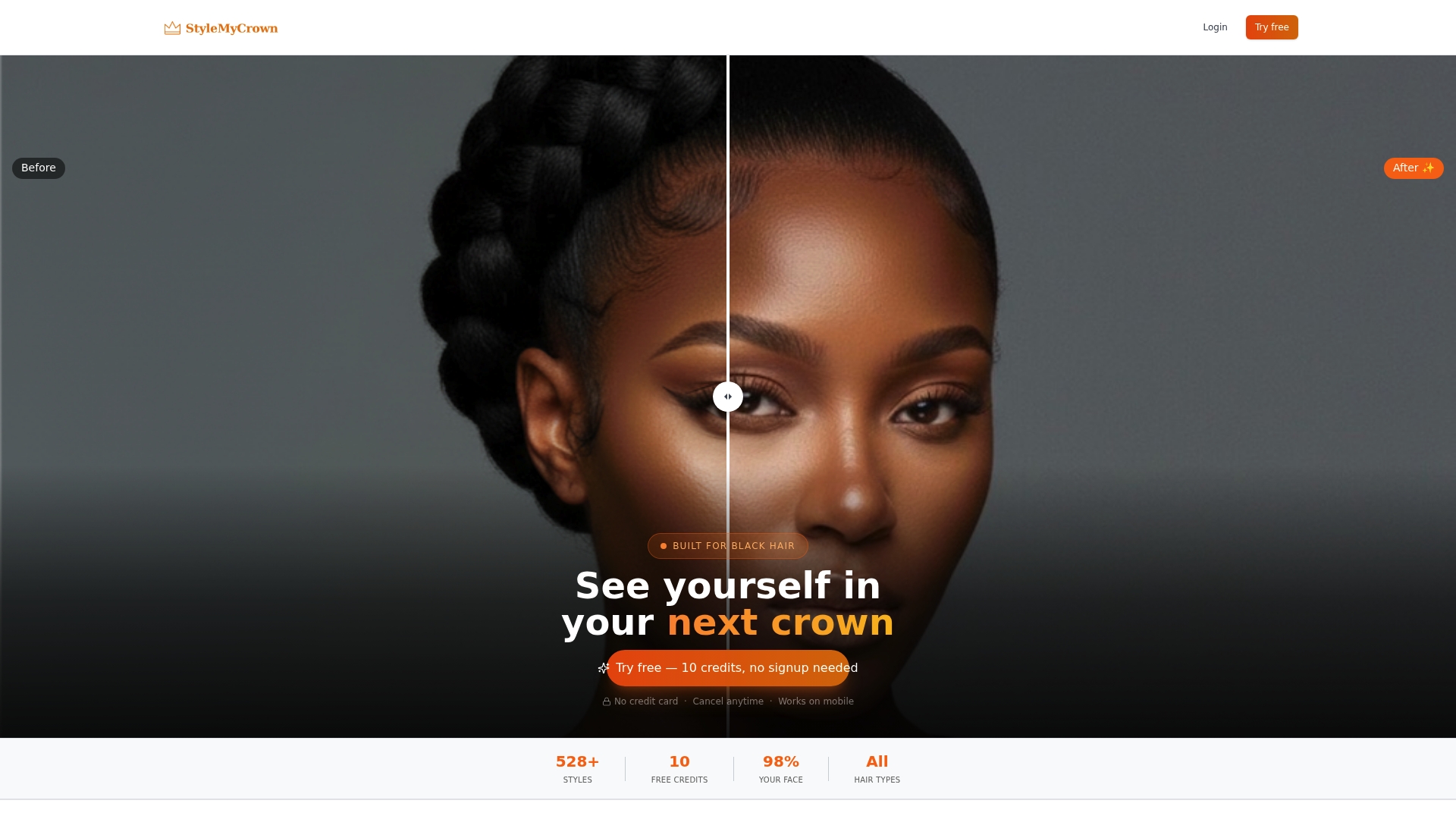
When you are ready to keep going, paid plans are listed on the pricing page: the 1 Week Trial is $17.48 per week and the 4 Week Plan is $38.73 per 4 weeks. Or start with your two free credits and see which look feels like you.
Stylists and shop owners can also use the catalog to cut consultation time. Details are on our pro onboarding page.
Our perspective
We hear the same thing again and again: people do not worry that they lack a good hairstyle. They worry about choosing the wrong one in a room where they cannot afford to be misread.
That fear is fair. The research shows natural hair has been judged unfairly, and no tidy tip sheet fixes that. What we can do is take the guesswork out of your side of the decision.
We built Stylemycrown around Black and textured hair because the catalog should start with you, not adapt to you as an afterthought. When you can see a sleek bun, a twist-out or a set of cornrows on your own photo, you stop imagining and start deciding. Confidence follows clarity.
Our advice is to preview, pick the style you can do well and keep it simple. A style you feel strong in will carry further than any perfect-on-paper option.
Christelle
Common mistakes to avoid
- Testing a new style the same morning. Rehearse it at least once.
- Over-gelling. It flakes and shines on camera.
- Fresh, tight installs. They can leave your scalp sore and your edges stressed.
- Constant touching. If your style invites fidgeting, it fails the comfort check.
- Copying a look that does not fit your length. Preview first.
- Changing your whole identity for the job. You can be polished and still be yourself.
FAQ
Can I wear my natural hair to an interview?
Yes. Natural styles such as twist-outs, puffs, flat twists and defined wash-and-gos are widely recommended when they are neat and intentional. Check the company’s norms and choose a polish level that matches. Where you live matters too, because CROWN Act protection varies by state.
Are braids or locs okay for an interview?
Yes, when parts are clean, edges are smooth and the length is tidy. Styling them into a low bun or pinning them back adds a conservative finish. Install or retwist at least four days ahead.
What is the safest hairstyle for a video interview?
Choose something controlled with no loose pieces and a matte finish. A low bun, flat twists, neat braids or a tidy puff all work. Skip high-shine products that reflect light on camera.
How do I choose between two styles?
Use the 3C check, then match the company’s tone. Preview both on your photo and pick the one you can recreate reliably. Familiar beats fancy.
Sources
- The Natural Hair Bias in Job Recruitment (Social Psychological and Personality Science)
- Discrimination based on hair texture in the United States (Wikipedia)
- How to Wear Your Hair for a Job Interview (Inspire Ambitions)
- How to Style Your Hair for a Job Interview (Republic Barber)
- Professional Recruiter Shares Best and Worst Natural Hair Interview Styles (Black Beauty Magazine)
- Professional natural hairstyles (Hair.com)
- Best Hairstyles for an Interview (L Salon)
- 16 Interview Hairstyles for Black Women (Corporate Curly)
- Planning a polished style for an interview or presentation (Hair You Love)
- Hair for a Job Interview: What to Know Before You Go In (Cadmen Academy)
- Job Interview Hair Styles (Tana’s Hair Designs)
- How to Wear Your Hair for an Interview (Indeed)


