Balayage on Natural Hair: What to Know Before You Lighten

Balayage works on natural hair, including 4A, 4B and 4C coils. The catch is that it has to be designed for your hair as it lives every day: dry, shrunken and grouped into coils, not stretched out on a chair. Plan the placement around that, expect lift to go slowly, and settle the overall look before the lightener ever touches your strands.
I have sat in enough salon chairs to know the feeling. You walk in with a photo of soft, sun-kissed ribbons on someone with straight hair, and you leave wondering where the color went. That gap between the photo and your own head is what this guide closes.
TL;DR
- Balayage is freehand painting with no foils. On natural hair it can be adapted to 4A, 4B and 4C patterns, but the plan has to start from your dry, shrunken coils.
- Dark, tightly coiled hair often needs a foil-assisted version (foilayage) and more than one session to reach caramel, honey or amber without damage.
- Tell your colorist everything: box dye, relaxers, extensions, products. Ask for a strand test and a low-and-slow approach.
- Expect a touch-up roughly every three to four months on curly hair, depending on how high the color sits.
- Preview the style, length and shape you want to wear first, then walk in with a clear picture instead of guessing.
Table of Contents
- What balayage actually is
- Why natural hair changes the rules
- Lift, shade and placement: what to ask for
- Before your appointment
- Settle the look before you color
- Aftercare and how often to refresh
- Going back to your natural color
- Try the look first
- Our perspective
- FAQ
- Sources
What balayage actually is
Balayage is a French word that means sweeping. A stylist hand-paints lightener or color onto selected strands, without foils or caps, so the transition looks soft and blended, like hair the sun got to.
Traditional highlights are different. Sections are woven out and wrapped in foil, which gives more uniform, structured lightening. Neither is better across the board. Foils give more defined results and show regrowth sooner, while balayage is chosen for softer regrowth and fewer visits.

That grow-out point matters for natural hair. Colorist Min Kim explains that balayage grows out more gracefully because it sits in vertical spaces, while foil highlights grow out in horizontal lines. If you want a lived-in look that does not announce a new appointment every six weeks, that is the appeal.
Why natural hair changes the rules
Most balayage photos online are straight or loosely wavy hair. Coils behave differently in three ways.
Shrinkage hides your work
Your 4C hair might measure many inches stretched and a fraction of that dry. A placement that looks generous on a stretched section can vanish once the coil springs back. One consultation guide frames coily color as a dry-state design problem: shrinkage and coil grouping can make a placement disappear, or push all the color onto fragile ends, if the stylist plans from stretched hair alone.
That is why you should show your colorist your hair the way you actually wear it, and bring dry-state reference photos.
Tight curls show flecks, not ribbons
On tighter coils, balayage reads as scattered points of brightness rather than long sweeping ribbons. Color sits on the top and outer portions of each coil, so lighter tones catch the light while deeper tones stay underneath. That is a beautiful effect, but it is not the straight-hair photo on your phone. Go in expecting sparkle and dimension, not streaks.
Coily hair is more fragile
Per one natural-hair balayage guide, 4C hair is typically more fragile, drier and more shrink-prone, so the colorist has to account for higher breakage risk instead of treating it like straight hair. Lightening is an oxidative service. Those services can disrupt the disulfide bonds inside the cortex, which lowers strength and elasticity, and surface conditioners cannot restore that inner damage on their own.
None of this is a reason to skip color. It is a reason to be picky about who does it and how.
Lift, shade and placement: what to ask for
Dark hair usually needs more than open-air painting
On dark brown or black hair, classic open-air balayage alone often cannot lift enough for visible dimension. A technique called foilayage, which pairs freehand painting with foil wrapping, is a standard approach for dark hair. The foil traps heat and moisture so you can reach caramel, honey or amber tones while keeping the blend soft instead of stripey.
There is a trade-off worth naming. Another natural-hair guide notes that going foil-free avoids added heat, which adds stress to already fragile textured hair. So the right method depends on your starting shade and how light you want to go. Ask your colorist which they would use on your hair and why.

Gradual lifting beats one big session
True brunette and black coils lift slowly. If you are after a big change, a good colorist may split it into several visits. Slow and low is the phrase to listen for: lower developer strength and slower processing. A pre-service strand test shows how your hair will actually respond before the whole head commits.
Section size and where color starts
Traditional balayage starts several inches from the roots for a lived-in grow-out, and it can be adapted to 4A, 4B and 4C patterns. Face-framing pieces can sit closer to the roots, according to L’Oréal Paris.
Section size is where coils get tricky. Chunky balayage uses roughly half-inch sections, rather than the quarter-inch or smaller typical of traditional work, but sections that are too big make the result look striped. Chunky, high-contrast sections can also look stripey when curly hair is worn straight, so tell your colorist if you press or stretch your hair sometimes.
Shade: warm or high contrast
Warm tones such as honey, caramel, amber and copper add depth without harsh contrast. Cooler or lighter tones such as ash and platinum create more contrast and tend to take more upkeep. On a brunette base, cinnamon or amber adds warmth without a hard line, and soft toffee or caramel adds depth on medium bases.
Balayage commonly concentrates color from the mid-lengths to the ends, with optional fine ribbons near the hairline, and the shade range runs from dark brown to pastels and vivid colors.
Before your appointment
Healthy hair takes lightener better. Matrix artistic director Michelle O’Connor recommends starting with hair that is healthy and strong, using protein or strengthening treatments beforehand, and cleansing and clarifying thoroughly on service day.
If smoothness and strength are on your mind, a pre-color step like a keratin hair mist for smooth hair can slot into your prep routine. Keep it simple and ask your colorist what they want you to use or avoid before the visit.
Hard water deserves a mention too. Metals in it can make hair dry and brittle and affect how color processes. If your tap leaves a film, mention it at your consultation.
The consultation checklist
This is the part that decides whether you love the result. Bring or say all of this:
- Dry-state photos. Show the hair as you wear it daily, plus a few reference images that also show textured hair.
- Your full color history. Prior salon color, box dye, relaxers, texture services, extensions and home-care products. Color history changes the result, so hiding box color helps no one.
- Your hair’s habits. Density, shrinkage, how it detangles, how dry it runs.
- A strand test request. It tells you whether your hair will lift and how fast.
- Three questions. What can change in one visit? What should stay untouched? How will the color fade?
Also ask about time and price upfront. Coils compress during processing, which makes lift hard to judge by eye, and the lifted shade reads lighter once the curl springs back and dries. Texture-aware finishing and detangling can add chair time, so get the total cost explained before work begins.
Do not stretch, bleach or aggressively detangle at home to copy a straight-hair map. It stresses the hair before the service even starts.
Settle the look before you color
Here is what I wish someone had told me years ago: balayage is only half of the decision. The other half is the style it will live in. Twist-out, silk press, braids, a TWA after a big chop, a tapered fade with a textured top. Color reads differently on each, and a shade you love on a defined twist-out can look flat on a stretched press.
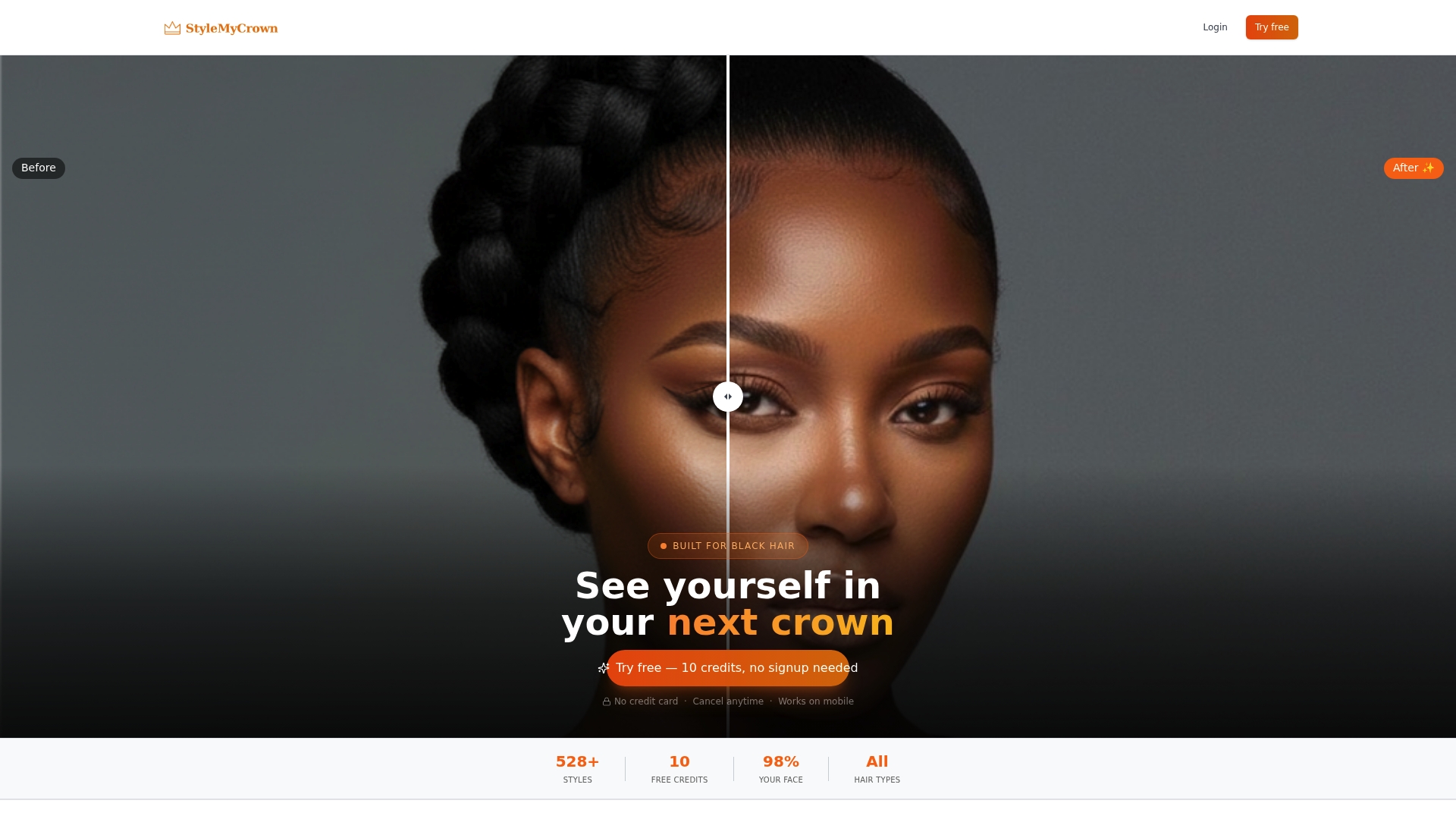
That is where a preview helps. StyleMyCrown lets you try over 528 styles curated for Black and textured hair on your own photo with augmented reality, so you can see the shape and length you want before you book anything. Walk into the consultation with a clear picture of the style, and the conversation about color gets much shorter and much more honest.
This matters in a few specific situations:
- Big chop or transition. Short, natural hair has less length to carry color. Previewing cuts first helps you decide whether to color now or let the length grow in.
- Parents. If you are choosing for a child, we would keep the conversation with a stylist about gentle, low-intensity options. Previewing styles lets your child pick the shape they love first.
- Men. Cuts, tapers and textured tops all frame color differently. Preview the cut, then talk about where the lighter tones belong.
- Stylists. A digital catalog on the table speeds up consultations. Our Stylist Catalog is built for exactly that.
Aftercare and how often to refresh
Color you cannot keep soft is color you will regret. Treat moisture and strength as the routine, not the extras.
- Moisturize and strengthen consistently. O’Connor recommends regular moisturizing and strengthening treatments for curly hair, and avoiding relaxers on the same strands.
- Go gentle on cleansing. Wella’s curly-hair guidance suggests a gentle cleansing routine and a richer treatment when curls feel dry, adjusted to your hair’s moisture and elasticity needs.
- Plan the refresh. O’Connor says curly-hair retouches typically happen every three to four months, and growth can take longer to become visibly obvious on coils. Wella notes that balayage may last three months to a year: higher placement near the roots may need refreshing around 6 to 8 weeks, and lower placement can last up to a year.
That last point is a design choice. Lower, blended placement gives a softer grow-out but a little less instant brightness. Higher placement is brighter but shortens the refresh interval. Tell your colorist how much upkeep your life has room for.
Going back to your natural color
The beauty of lower, blended placement is that it grows out with grace. Because color starts several inches from the roots, there is no harsh regrowth line to chase. If you want to return to your natural shade, talk with your colorist about gradually softening the lighter pieces and trimming them as your natural hair grows in, rather than coloring over everything at once. Keep up moisture and strengthening treatments while you do.
Try the look first
If you are weighing a new color, a new cut, or a new protective style, start by seeing it on you. With StyleMyCrown, you get 2 complimentary credits to try styles on your own photo, so you can explore without commitment. The 1 Week Trial is $0 per week, and the 4 Week Plan is $38.73 per 4 weeks if you want to keep exploring. Our face data is processed securely and is never retained or used for AI training.
See what is on offer on our pricing page, or head to StyleMyCrown and start browsing styles built for Black and textured hair.
Our perspective
I remember sitting in a chair, holding a picture of hair that looked nothing like mine, and hoping for the best. Sometimes the best arrived. Sometimes it came out flat, or my coils tucked the color away where nobody could see it.
What changed for me was walking in prepared. When I knew the shape I wanted, how I wear my hair on a normal Tuesday, and what I was willing to maintain, the whole consultation changed. The colorist could plan around my coils, not around a stock photo.
That is why we built StyleMyCrown for Black and textured hair. With over 528 styles curated for different textures, you can see yourself first. You decide what feels like you. Then you bring that clarity to the person holding the brush.
Your hair is not a problem to be solved. It is a crown to be styled on your terms.
Christelle
FAQ
Can you do balayage on 4C hair?
Yes. Balayage can be adapted to 4A, 4B and 4C patterns when the colorist understands the texture. Expect narrower, carefully placed sections, a gradual lift that may take more than one visit, and a plan built around your dry, shrunken hair.
Is balayage or highlights better for natural hair?
Neither is universally better. Foils give more defined, uniform lightening and are often used for dark hair that needs significant lift. Balayage gives a softer, more blended grow-out and usually fewer touch-ups. Many colorists combine the two as foilayage on dark coils.
How long does balayage last on curly hair?
Curly-hair retouches typically happen every three to four months. Placement matters: color near the roots may need refreshing at around 6 to 8 weeks, while lower placement can last up to a year, according to Wella Professionals.
Will balayage change my curl pattern?
Lightening can reduce strength and elasticity, which is why a strand test, lower developer and a bond-protecting plan matter. Starting with healthy hair, using strengthening treatments and keeping up moisture afterward give your curls the best chance of staying defined.
Sources
- L’Oréal Paris: How to do balayage for curly hair
- Glamour: Balayage vs. highlights
- Redken: Balayage vs highlights
- Wella Professionals: Your complete guide to balayage
- Wella: How to do balayage for curly hair
- BalayageVA: Balayage for coily hair
- IlonaR Style: Balayage on curly hair
- HUM Nutrition: Balayage for natural hair
- The Tease: The science of bonding
- Tangerine Salon: Balayage for all hair types
- Noelle Salon: Balayage curly hair secrets
- The Tease: Michelle O’Connor’s balayage tips
- The Tease: Metals in hard water


