2 Free Credits: StyleMyCrown, Texture First Hair App for Black Hair
2 Free Credits: StyleMyCrown, Texture First Hair App for Black Hair
This haircut app is designed around textured hair instead of retrofitting a generic tool to handle it. With a curated style catalog and a layered pipeline designed to preserve actual features, it addresses accuracy issues common in virtual try-on apps. You can test it yourself with two complimentary trial credits before any payment.
TL;DR:
The app offers two free credits to test its accuracy on textured and coily hairstyles, focusing on identity preservation and realistic style matching.
Most failure modes, like style copying without adaptation or facial feature shifts, occur mainly on darker skin tones and coiled textures due to dataset limitations.
Successful evaluation relies on matching curl patterns and textures, using proper lighting, and avoiding filters or obstructions that hinder edge detection and segmentation.
The app’s layered validation system refuses low-confidence results to prevent distorted or incorrect images, emphasizing the importance of early-style testing with dramatic hairstyles.
Feedback from testing helps refine the catalog, and users should report flawed results with original photos to improve future accuracy.
Table of Contents
Why StyleMyCrown Fits People With Black Hair
Most try-on apps treat Black hairstyles as an afterthought, one filter among hundreds built for straight or wavy hair. StyleMyCrown flips that order. The catalog includes numerous styles spanning locs, bantu knots, twists, cornrows, and a range of braided and protective looks.
The trial structure matters just as much as the catalog. Every new account gets two complimentary credits to test the app on your own photo before committing to a subscription. That’s the actual value of a free haircut simulator: you get to judge the accuracy yourself instead of taking a screenshot on faith.
Behind the scenes, the app runs a layered validation pipeline that checks each generated image for identity drift before it reaches your screen. When a result doesn’t clear that bar, the system refuses and preserves your credit rather than providing a photo that doesn’t look like you.
What you get:
-
A catalog built around textured hair categories, not generic hairstyle templates
-
Two complimentary credits to test accuracy before paying anything
-
A validation step designed to catch and block low-confidence results
-
Editorial guidance on matching styles to your texture and face shape
Pro Tip: Start your first test with a style far from your current look, like a full afro crown or a loc updo. Dramatic changes expose weak try-on tools fast, so if the app holds up there, it’ll hold up on subtler edits too.
Why Do Try-On Apps Get Black Hair Wrong?
Several recurring failure modes explain almost every bad result you’ll see from a haircut app, and knowing them helps you spot a broken tool.
Catalog echo happens when the app just pastes a stock reference image over your face instead of adapting the style to your actual head shape and hairline. No-op is when nothing changes at all. You upload a photo, request braids, and get your original picture back with a new file name. Identity transfer, sometimes called prior drift, is the most unsettling failure: the model changes your face along with your hair, sliding your features toward whatever face the training data associates with that hairstyle. Timid-edit is the opposite problem, a result so cautious it barely resembles the requested style. And segmentation failures occur when the software can’t correctly separate hair from scalp, ears, or background, which shows up as blurred edges or hair that appears to float.
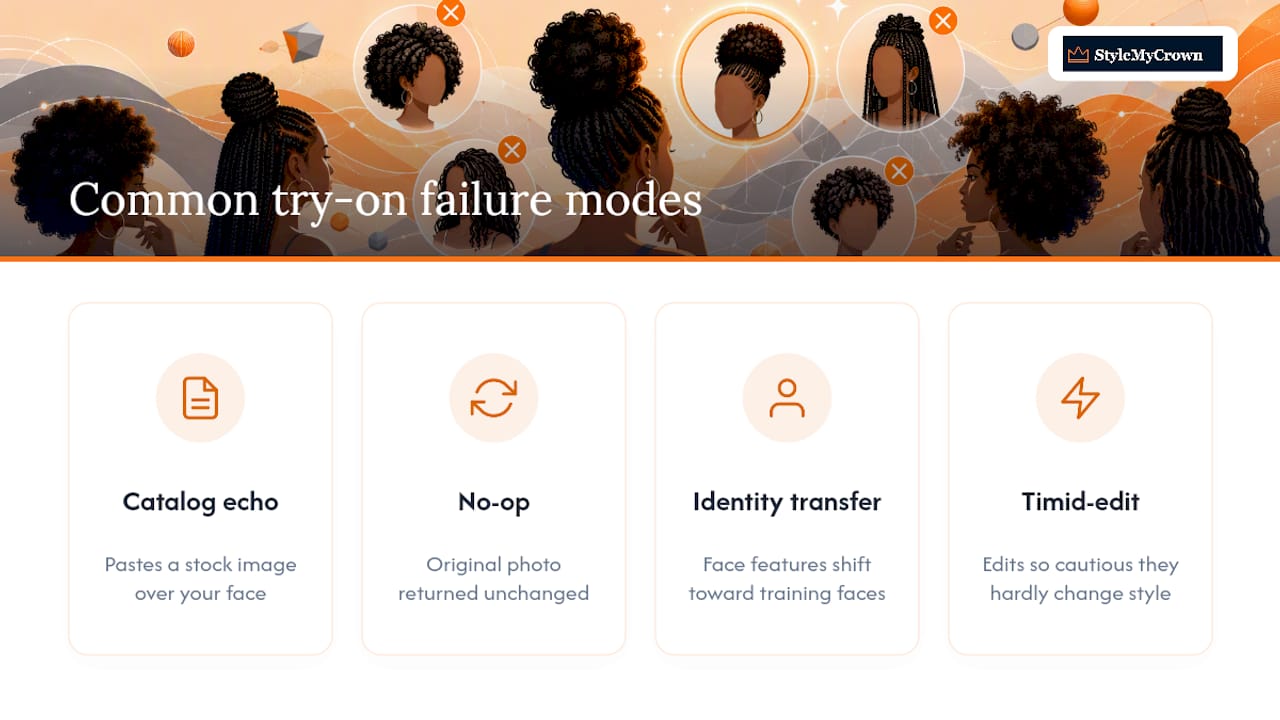
These failures cluster around darker skin tones and coily, tightly coiled textures because most general-purpose models were trained on datasets that underrepresent both. Underrepresentation in training data is the root cause, not a coincidence.
The fix documented in current try-on research combines masked-inpainting, which locks facial identity in place as a physical constraint rather than a suggestion, with layered validation gates that cross-check multiple signals before releasing an image. Production systems built this way log facial-embedding distances, visual-quality scores, and perceptual-hash comparisons for every candidate result, then apply refusal semantics that preserve identity instead of forcing a bad delivery.
Set your expectations with the numbers: ongoing survey-based research into AI hairstyle accuracy uses a 51% participant agreement threshold to judge whether a depiction counts as accurate, a benchmark from a Spelman College study on AI and Black hairstyles. That’s the bar general-purpose tools are struggling to clear, which is exactly why texture-specific engineering matters.
How Do You Evaluate a Haircut Try-On App?
Before trusting any result, run through this checklist:
-
Confirm the app explicitly names textured or coily hair as a supported category, not just “curly.”
-
Check for a dedicated braided and loc-style section in the catalog, not a single token entry.
-
Look for a sample gallery featuring people with skin tones similar to yours.
-
Read the refund or credit policy. A trustworthy app tells you what happens when a result fails.
-
Search for any published explanation of how the app verifies its own results.
Once you’ve cleared that list, run these five quick tests yourself:
-
Upload a plain frontal photo and request a high-volume style like an afro crown.
-
Request a braided style, like knotless braids or cornrows, in the same session.
-
Compare your face in the result to your original photo. If your features shifted, that’s identity drift.
-
Try an intentionally difficult request to see if the app refuses gracefully instead of forcing a bad result.
-
Run the same style twice using two different catalog references and compare fidelity.
Red flags to walk away from immediately: no trial credits offered anywhere, a gallery with zero examples resembling your skin tone or texture, or a portfolio of “before and after” photos where the after shot is clearly a different person. Early try-on tools built as simple 2D overlays often show all three at once, since they lack real volume modeling or identity preservation to begin with.
How Do You Get Accurate Try-On Results?
The photo you upload does most of the work before the app even runs. A few habits make a measurable difference:
-
Shoot against a neutral, uncluttered background so the app’s edge detection isn’t fighting your wallpaper.
-
Use even, diffuse lighting. Harsh overhead light or a phone flash creates shadows that get misread as hairline or scalp.
-
Keep your hairline and scalp visible. Hats, hoods, and heavy filters remove the reference points the app needs.
-
Skip beauty filters entirely. They smooth out the exact facial contours the validation step relies on.
When picking a reference style, match curl pattern, density, and parting to your own hair as closely as the catalog allows. A loc style chosen for its length alone, ignoring your actual density, will always look less convincing than one chosen for texture match first.
Once you get a result, learn to read it. A low-confidence delivery usually looks slightly soft around the hairline or shows minor blending artifacts, still recognizably you. A harmful substitution changes your actual facial structure. If you see the second one, don’t keep tweaking the prompt. Save the original photo and the result side by side, note the style you requested, and report it. That pairing is the fastest way for any support team to diagnose what went wrong.
Pro Tip: If a result looks even slightly off, retry once with a slightly different reference image before requesting a refund. Sometimes the issue is a mismatched parting, not a broken model.
Ready to Try StyleMyCrown for Yourself
Talk is cheap when it comes to try-on accuracy, so test it directly. Head to the Style Catalog and browse the full range of textured, braided, and protective styles before you commit to anything.
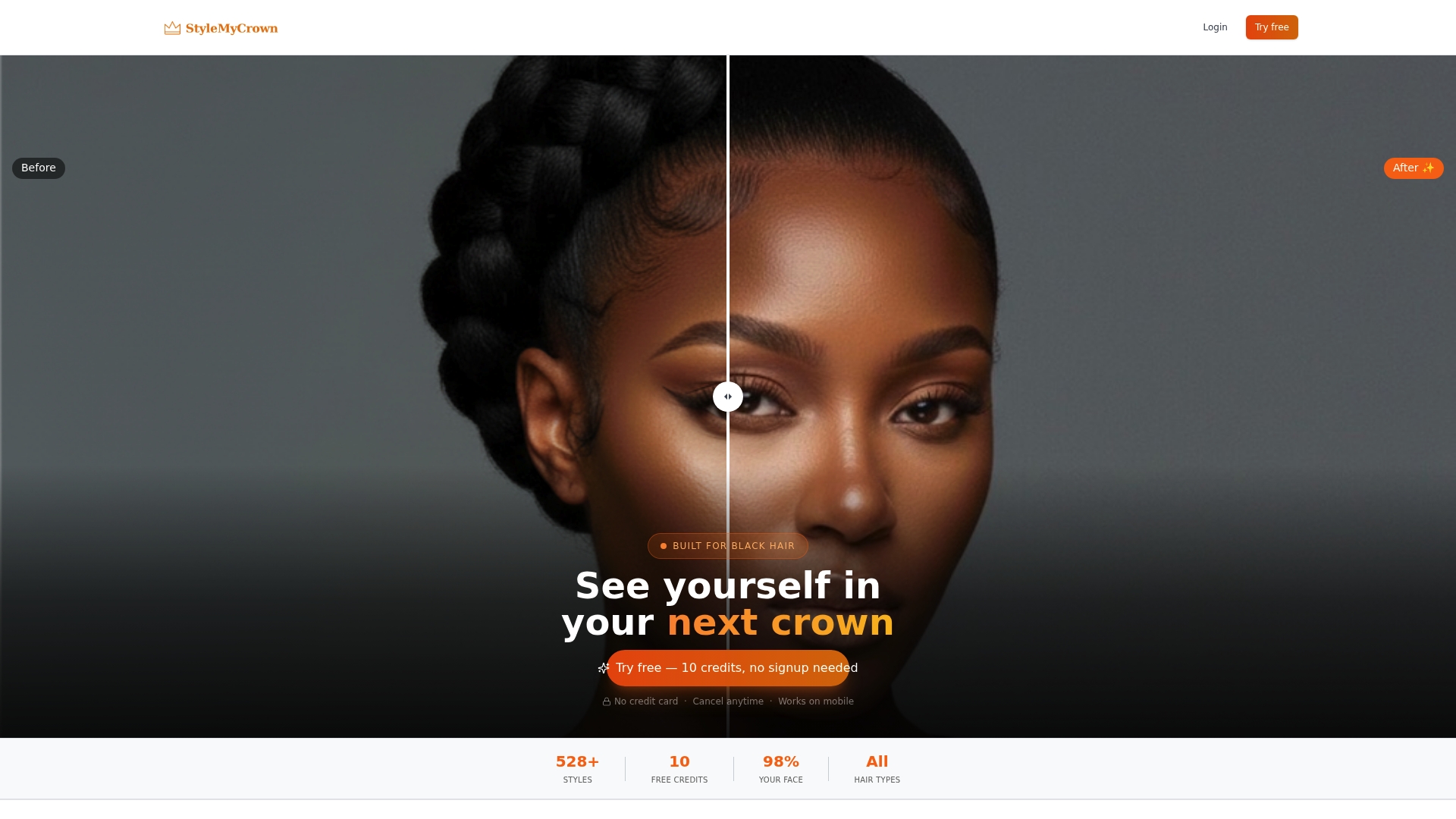
For your first two complimentary credits, run the two tests that reveal the most: a voluminous afro crown to check volume and identity preservation, and a knotless braid style to see how the app handles a fine, high-detail pattern. Between those two, you’ll see exactly how the validation pipeline behaves, whether it delivers a confident result or refuses gracefully when it can’t clear its own accuracy bar. If you work with clients or want stylist-level matching, the Stylist Catalog is worth a look too. Either way, start from the StyleMyCrown home page and put your own photo through the process. That’s the only test result that matters.
Why Centering Black Hair Changes Everything
I’ve spent enough time in this space to notice a pattern: the apps that fail Black hair users aren’t failing because the problem is unsolvable. They’re failing because textured hair was never the design target in the first place. It got added later, as a checkbox, and the results show it.
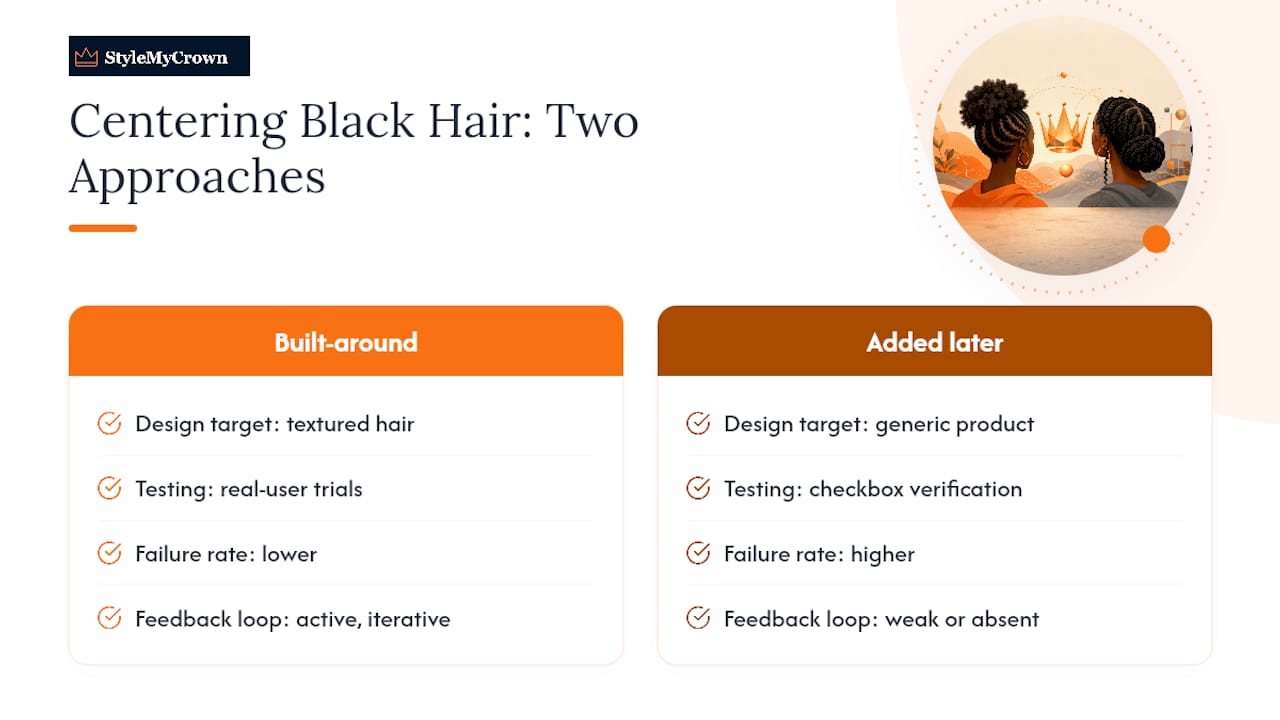
That’s the gap most reviews miss. They test whether an app “supports” curly hair without asking whether it was built around it. Those are different products with different failure rates.
The catalog StyleMyCrown runs today grew out of actual feedback from people testing it against their own hair, not a boardroom guess at what “diverse” should look like. If you try it, push it. Test the style you think will break it. Then tell us what you found. That feedback loop is exactly how the catalog keeps getting sharper.
— Christelle
Sources
-
Spelman scholar using data to improve how AI represents Black women’s hairstyles — CBS News
-
Spelman College graduate launches study exposing AI shortcomings on Black hairstyles — AfroTech
FAQ
Is StyleMyCrown Really Free to Try?
Yes. New accounts get two complimentary credits to test the app on their own photos before any payment is required.
What Makes a Haircut App Accurate for Black Hair?
Accuracy depends on whether the app was built around textured hair data, uses identity-preserving techniques like masked-inpainting, and applies validation checks before delivering a result, all features StyleMyCrown’s pipeline is designed around.
Can These Apps Handle Braided and Loc Styles?
Yes, but unevenly across the market. Braided styles are documented as one of the hardest categories for general AI tools, which is why a dedicated braid and loc catalog matters more than a generic “curly hair” filter.
What Should I Do if a Try-On Result Looks Wrong?
Save your original photo alongside the flawed result, note the exact style requested, and report it through the app’s support channel so the issue can be diagnosed against the specific catalog reference used.


