Black Hairstyle Websites for Accurate References and AR Try-On
Black Hairstyle Websites for Accurate References and AR Try-On
If you’re searching for a Black hairstyle website, you need one of four things: a reference library with real terminology, an editorial gallery for trend inspiration, an educational hub that teaches you your hair’s actual needs, or an AR tool that shows the style on your own face before you commit. Most people need at least two of these working together. For the last one, StyleMyCrown built its platform specifically for that gap, offering over 528 curated hairstyles matched to different textures, with 10 free credits to test the technology before paying for anything.
- Reference libraries (naming, filters, real images) for stylist-ready requests
- Editorial galleries for trend spotting and seasonal looks
- Educational hubs for understanding porosity, density, and curl pattern
- AR virtual try-on for seeing the style on yourself, risk free
Quick stat: StyleMyCrown’s catalog of 528+ styles covers a wider texture range than most single-source galleries, and the 10 complimentary credits mean you can test a look before spending a dollar.
Start by opening a filtered reference gallery to find the right name for what you want, then try it on with AR before you book anyone.
Key Takeaways
The most reliable path from hairstyle inspiration to a confident result combines accurate reference naming, hair-type education, and AR try-on before booking a stylist.
| Point | Details |
|---|---|
| Use reference libraries for naming | Sites like Afro Index pair images with accurate terminology to prevent stylist miscommunication. |
| Pair education with inspiration | Learn porosity, density, and curl pattern before choosing a style to avoid guesswork. |
| Check for texture-specific filtering | Prioritize sites that filter by 3A through 4C rather than treating Black hair as one category. |
| Preview before you commit | AR try-on shows how a style looks on your actual face and hair before any appointment. |
| Try StyleMyCrown’s AR catalog | StyleMyCrown offers 528+ curated styles and 10 free credits to test looks risk-free. |
Table of Contents
- What Do the Best Black Hair Websites Actually Offer?
- How Do You Choose the Right Hairstyle Site for Your Goal?
- Which Type of Resource Fits Your Specific Need?
- First-Hand Proof: Closing the Gap Between Inspiration and Confidence
- Where Do You Find Community Reviews and Shared Hairstyle Experiences?
- Why Do Cultural and Historical Roots Matter in a Hairstyle Gallery?
- How Do You Match a Hairstyle to the Season or Occasion?
- Are These Hairstyle Resources Available as Mobile Apps?
- What Common Hairstyle Problems Do These Sites Help Solve?
- Sources
What Do the Best Black Hair Websites Actually Offer?
A genuinely useful Black hairstyle website gives you more than pretty pictures. It gives you the tools to act on what you see.
The strongest sites share a few non-negotiable features. High-resolution images shot from multiple angles matter more than people realize, because a style that looks flawless from the front can hide a completely different parting pattern or braid direction from behind. Sites like Afro Index build entire libraries around this principle, pairing reference images with accurate naming so a “Fulani cornrow” isn’t confused with a “tribal braid,” a mix-up that happens constantly and wastes appointment time.
Naming precision solves a real problem. Vague terms like “boho braids” mean different things to different stylists, and that gap creates miscommunication in the chair. A representation gap in naming and documentation has been a long-standing frustration for anyone trying to describe a style accurately.
Beyond naming, the best sites offer:
- Filtering by texture (3A through 4C), length, and protective versus styling function
- Educational sections covering porosity, curl pattern, and maintenance routines
- Save, download, and share options so you can hand a stylist an exact reference
Skip any site missing more than two of these.
How Do You Choose the Right Hairstyle Site for Your Goal?
Not every site serves the same purpose, and picking the wrong one wastes time. Match your goal first, then pick the tool.
If you want inspiration, an editorial gallery works fine. If you want to understand your hair before choosing anything, you need an educational hub. If you want to walk into a salon with confidence, you need a reference library and, ideally, a way to preview the look on yourself first.
Run through this checklist before trusting a site with your next style:
- Does it specify hair type or texture range, or does it treat “Black hair” as one category?
- Does it use consistent naming and tags, or vague trend labels?
- Are the reference images sharp, well-lit, and shot from more than one angle?
- Does it pair styles with any educational context, like maintenance or suitability?
- Can you save or export an image easily to show a stylist?
Watch for red flags: inconsistent naming across the same style, entertainment-only galleries with no filtering, and a noticeable shortage of 3C to 4C texture representation, which remains common even on sites that claim to serve “natural hair” broadly.
Pro Tip: Screenshot the exact reference image plus its listed name and texture tag, then send both to your stylist in the same message. “This one, called Feed-in Cornrows with Curly Ends, for 4B hair” gets you a far more accurate result than “something like this.”
Which Type of Resource Fits Your Specific Need?
Four categories dominate this space, and each solves a different problem.
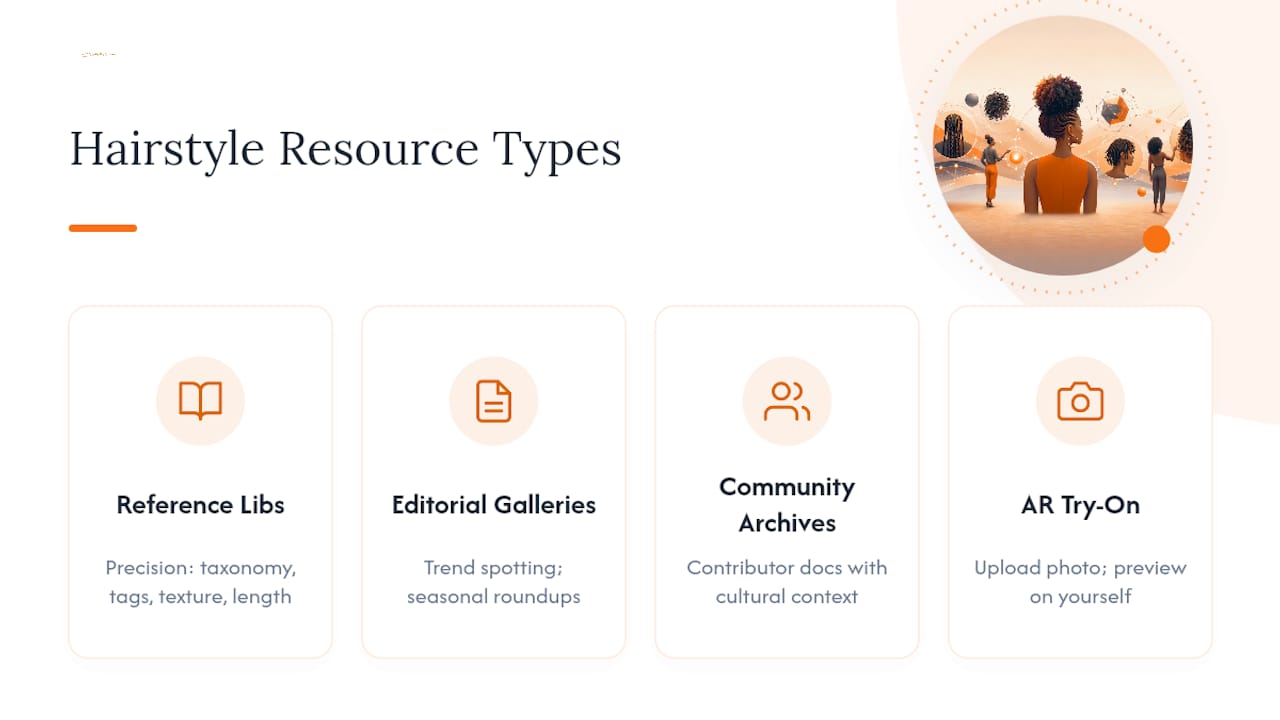
Reference libraries exist to give you precision. Sites like Afro Index prioritize taxonomy and tagging, protective status, texture match, and length buckets, because vague inspiration doesn’t help a stylist execute a look. If you’re building a brief for an appointment, this is where you start.
Editorial galleries serve a different purpose entirely: trend spotting. Outlets like Black Beauty & Hair publish seasonal roundups and celebrity-driven looks that keep you current, though coverage of specific textures and educational depth varies a lot from one gallery to the next. Treat these as a mood board, not a technical reference.
Open-source and community archives fill a gap the mainstream editorial cycle often misses. The Open Source Afro Hair Library is built by contributors documenting styles with cultural context that commercial sites rarely include, widening representation beyond whatever happens to be trending on a given month.
AR and interactive try-on tools are the newest category, and arguably the most practical. Instead of imagining how a style might look, you upload your own photo and see it rendered on your actual face and hair. This closes the biggest gap in the other three categories: none of them tell you whether a style suits you personally. A gallery can inspire you and a glossary can name the look accurately, but only a try-on tool answers the question that actually matters before you sit in a chair.
First-Hand Proof: Closing the Gap Between Inspiration and Confidence
We built StyleMyCrown because we watched the same pattern repeat: someone finds a gorgeous reference image, walks into a salon, and leaves disappointed because nobody could confirm beforehand whether that style would work on their face shape or texture. Reference libraries solve the naming problem. They don’t solve the “will this actually look good on me” problem.
Our AR try-on addresses that directly. The catalog includes 528+ styles curated across texture types, and every new user gets 10 complimentary credits to test looks before paying anything.
The practical workflow looks like this:
- Pick styles matched to your texture instead of scrolling generic trend lists
- Try them on with AR and screenshot the ones that work
- Pair each screenshot with the accurate name and tags from a reference library
- Bring both to your stylist for a request with zero ambiguity
That combination, name plus visual proof, is what actually gets you the result you asked for.
Where Do You Find Community Reviews and Shared Hairstyle Experiences?
Galleries and glossaries tell you what a style is called and how it’s supposed to look. Community features tell you how it actually performed for someone with hair like yours, which is a different kind of information entirely.

Forums and comment sections attached to hair-care hubs let people report how a protective style held up after three weeks, whether a product caused buildup, or whether a particular braid pattern caused tension at the edges. This kind of peer feedback catches problems that a polished editorial photo never will. A single glossy image can’t tell you that a style takes four hours to install or that it’s murder on fine 4A strands.
Review-driven communities also surface stylist recommendations by name, which matters more than most sites acknowledge. A stylist skilled at silk presses isn’t automatically skilled at locs, and community threads tend to be blunt about that distinction in a way marketing pages never are.
Sharing features, where users post their own results next to the reference photo, do something else useful too: they show you real outcomes across different hair densities and lengths, not just the one model used in the original shoot. That’s a meaningful gap in representation that community content fills better than any curated gallery can on its own.
If a site you’re using has zero community layer, treat its images as a starting point only, and look elsewhere for real-world confirmation before committing to anything time-intensive or expensive.
Why Do Cultural and Historical Roots Matter in a Hairstyle Gallery?
A photo without context strips a hairstyle of its meaning. Cornrows date back thousands of years across West African cultures, historically used to signal age, marital status, ethnicity, and social rank, not decoration. Bantu knots carry a name tied directly to the Bantu-speaking peoples of Southern Africa. Treating either as a generic “trend” erases that history.
The strongest hairstyle resources build this context directly into their galleries instead of treating it as an afterthought. Knowing that a style has deep cultural roots changes how you talk about it, request it, and wear it. It also helps you recognize when a style is being repackaged and renamed by mainstream fashion media without any acknowledgment of where it came from, something that happens often enough that it’s worth watching for.
Sites that pair an image with even a sentence of origin do more for the culture than a hundred images with no context at all. This is also where naming precision and cultural respect intersect: calling a style by its accurate name, rather than a vague trend label invented for a magazine headline, is a small act that keeps the history attached to the style instead of scrubbing it out. When you’re choosing which hairstyle websites deserve your attention, this is a real differentiator, not a nice extra.
How Do You Match a Hairstyle to the Season or Occasion?
The right style depends heavily on climate, event, and how long you need it to last, and the best hairstyle sites organize content around exactly that logic instead of dumping every style into one undifferentiated feed.
Summer and humid climates tend to favor protective styles, box braids, twists, cornrows, that resist frizz and reduce daily manipulation. Winter months often call for moisture-retentive styles since indoor heating and cold air both strip hydration faster. Weddings, job interviews, and formal events typically call for sleeker, more polished looks, while festivals and everyday wear tolerate more texture and volume.
A well-organized gallery lets you filter by occasion the same way you’d filter by texture. If a site only offers a single undifferentiated feed with no seasonal or event-based sorting, you’re stuck manually cross-referencing every style against your own calendar, which defeats the purpose of using a curated resource in the first place.
This is also where AR try-on adds real value beyond the reference stage. Instead of guessing how a sleeker style will photograph under wedding lighting or how a protective style will hold up through a beach vacation, you can preview the look on your own face ahead of time and decide if it fits the occasion before you’ve committed a single dollar or hour in a salon chair.
Are These Hairstyle Resources Available as Mobile Apps?
Most people research hairstyles on a phone, standing in line, scrolling during a commute, and the sites that recognize this win more repeat visits than the ones that don’t. A desktop-only gallery with tiny thumbnails and no mobile optimization is a frustrating experience when you’re trying to save a reference image at 11 p.m. before a morning appointment.
Look for mobile responsiveness at minimum: images that load fast, filters that work with a thumb instead of a mouse, and a save function that doesn’t require ten taps. Native apps take this further by letting you build a saved folder of references you can pull up offline, in a salon, with no signal.
AR try-on tools depend on mobile usability even more directly, since the entire feature relies on your phone’s camera and a live or uploaded photo. A clunky mobile experience defeats the purpose of a try-on tool built to remove guesswork. StyleMyCrown’s Style Catalog is built with this in mind, so browsing and trying on styles from a phone works the same way it does on a larger screen.
Before committing time to any hairstyle resource, check how it performs on the device you’ll actually use most. A beautiful desktop catalog that breaks on mobile isn’t a resource you’ll return to.
What Common Hairstyle Problems Do These Sites Help Solve?
The most useful hairstyle sites don’t just show you options, they help you troubleshoot when something goes wrong or when you’re stuck deciding between two similar styles.
Common friction points include picking a style that doesn’t suit your face shape, requesting a look your stylist interprets differently than you intended, or choosing a protective style that turns out to be too heavy for your hair’s density. Educational hubs like Curl Centric address the root cause of a lot of these problems: getting porosity, density, and curl pattern wrong turns product and style selection into guesswork. Understanding your hair’s actual behavior before you pick a style prevents most of the trial-and-error that leads to disappointment.
Miscommunication with a stylist is another recurring issue, and it’s almost always solvable with better preparation. Bringing a reference image plus its accurate name, sourced from a proper glossary rather than a vague trend label, closes most of that gap immediately. Sites like Black Hair Care 101 round this out with structured routine guidance, so you’re not just picking a style but also learning how to maintain it once it’s installed.
The pattern worth remembering: browsing alone rarely solves these problems. Pairing a visual reference, an accurate name, some hair-type education, and, where possible, a try-on preview solves almost all of them before you ever sit in a chair.
Why representation and accuracy matter more than trend-chasing
We’ve watched the hairstyle content space get flooded with generic “which braids are trending” listicles that ignore texture, history, and fit entirely. That approach photographs well and helps almost nobody make an actual decision.
What we push for instead, and what shaped how we built this guide, is pairing accurate naming and hair-type education with a way to actually see the result on yourself. A glossary tells you what something is called. Education tells you why it might or might not work for your hair. Neither tells you whether it suits your face. Combine all three, and you stop guessing.
— Christelle
Try Your Next Style Before You Book It
StyleMyCrown gives you what a static gallery can’t: a way to see a hairstyle on your own face before you spend a cent or sit in a salon chair. It’s built specifically for Black hair, with over 528 curated styles spanning different textures, so you’re not stuck adapting a look meant for a different hair type.
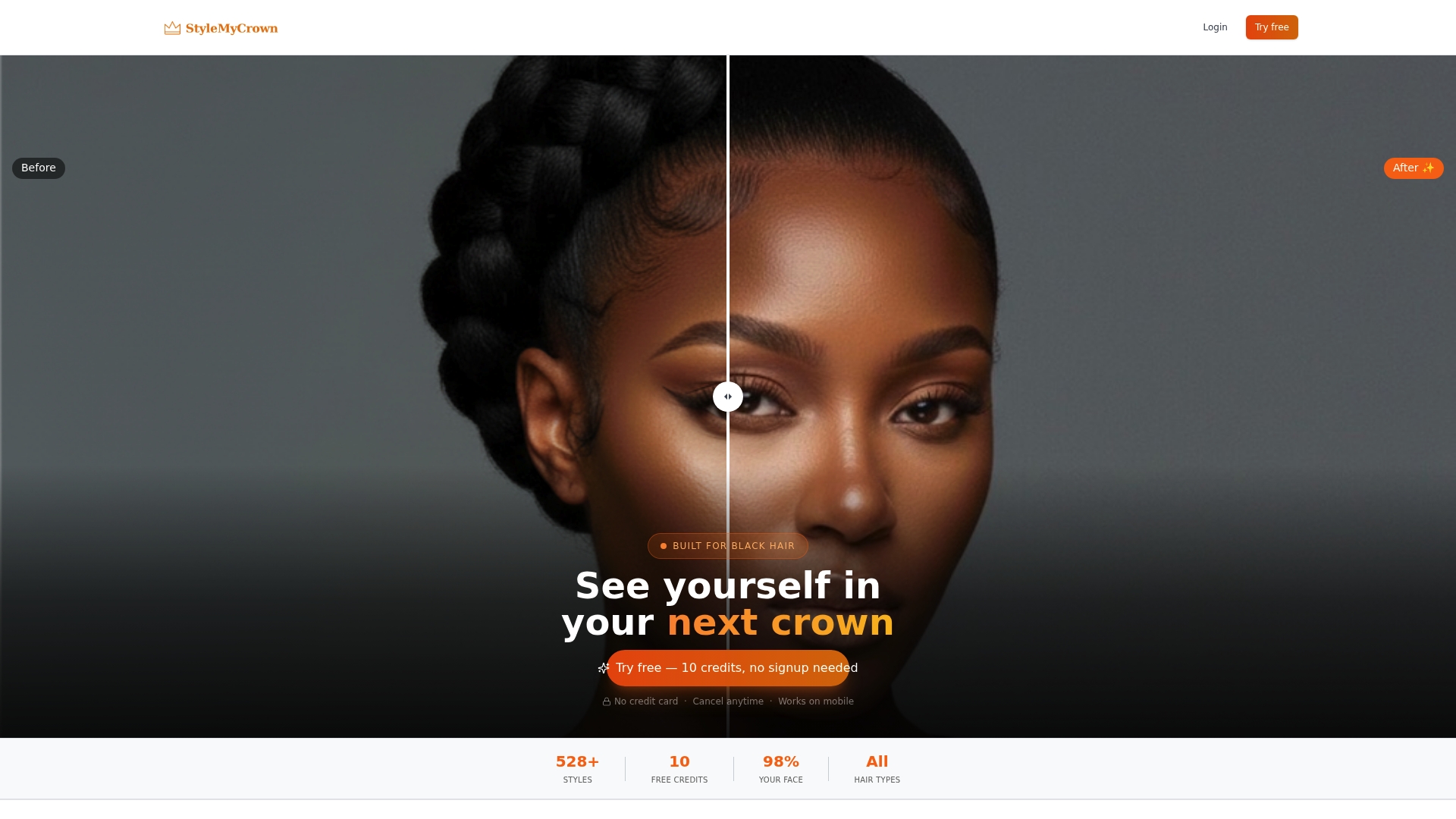
Getting started takes two steps. First, create a free account. Second, use your 10 complimentary credits to try on styles matched to your texture, no payment required to start. Browse the full Style Catalog to find looks sorted by texture and length, or head to the StyleMyCrown homepage to see how the tool works before you upload a photo. Once you find a look you love, the Stylist Catalog helps you connect that saved reference to a professional who can bring it to life.
Sources
- Afro Index - Black Hairstyle Reference Library
- Curl Centric | Curly Hair Care, Hairstyles & Growth Tips
- Open Source Afro Hair Library
- Black Hair Care Made Simple - Black Hair Care 101


