Best No Tension Styles for Black Hair That Protect Your Edges

The best no tension styles are the ones that use your own hair, sit loose at the hairline and put no weight on your roots. That means two-strand twists, flat twists, Bantu knots, twist-outs, braid-outs and wash-and-gos. Knotless braids and braided buns can work too, if they are installed light and loose. Below, I compare each one on tension, upkeep and how long it lasts, so you can pick what your edges can handle.
I have sat in the chair and felt that first hard tug at the temples. I smiled through it because I thought that was the price of a good style. It is not.
TL;DR
- Your safest bets are twists, flat twists, Bantu knots, twist-outs and braid-outs. They are low-tension options that leave ends exposed while easing scalp pull.
- Knotless braids and braided buns can be gentle when they are lightweight and the hairline is left soft.
- Pain, stinging, bumps or throbbing mean the style is too tight. Loosen it or take it out.
- Give your hair a rest between installs, and wash your scalp regularly while the style is in.
- Preview a style on your own photo before you book, so you commit to the look and not the tension.
Table of Contents
- What “no tension” really means
- Why your edges deserve the extra thought
- The best no tension styles, compared
- Protective styles for edges: what to ask your stylist
- How to tell a style is too tight
- Caring for your scalp under a low tension style
- How long to keep it, and when to rest
- Perspective
- Try your next style before you commit
- Which style should you pick?
- FAQ
- Sources
What “no tension” really means
No style is literally zero tension. Any style that holds hair in place pulls a little. What readers mean by “no tension” is low tension: nothing yanking at the roots, nothing heavy hanging from the hairline.
Curl Centric describes low-tension protective styles as ones that keep hair in place without pulling on the strands. They do it by avoiding extension weight at the hairline, or by spreading weight along the braid instead of tying it off at the root.
That gives you a simple test for any style you are considering:
- Does it add weight at the edges?
- Is the hair pulled into a tight, slicked perimeter?
- Will it stay in longer than your scalp is happy with?
If the answer to all three is no, you are in good shape.
Why your edges deserve the extra thought
Edges are the finest hair on the head, and they take the most pulling. Board-certified dermatologist Jeanine Downie, MD, warns in Allure’s protective style guide that a style that is too tight or heavy can cause severe traction. She says that can disrupt the hair-growth cycle and lead to scarring and permanent follicle damage.
A clinic in London, the Fulham Scalp and Hair Clinic, says traditional braiding techniques can cause excessive tension that leads to traction alopecia. Their advice for natural hair without extensions is chunky cornrows and French plaits.
This is not about fear. It is about knowing that the “protective” part of a protective style only works when the style is gentle.

The best no tension styles, compared
Here is how the main options stack up. The wear times come from Cosmopolitan’s protective style guide, which gives 4 to 12 weeks for braids and twists, 2 to 8 weeks for cornrows and 1 to 2 weeks for Bantu knots. Treat those as outer limits, not goals. Shorter is kinder to thin edges.
| Style | Tension on edges | Uses only your hair? | Typical wear time | Upkeep level |
|---|---|---|---|---|
| Wash-and-go | Very low | Yes | Until next wash | Low, but needs moisture and detangling |
| Two-strand twists | Low | Yes | Up to several weeks | Moderate |
| Flat twists | Low to moderate | Yes | 1 to 2 weeks or more | Moderate |
| Twist-out or braid-out | Low | Yes | Several days per set | Moderate |
| Bantu knots | Low if kept loose | Yes | 1 to 2 weeks | Low to moderate |
| Flexi rod set | Low | Yes | Several days | Moderate |
| Knotless braids | Low to moderate | Usually adds hair | Up to about two months | Higher |
| Soft low bun or puff | Low if not yanked tight | Yes | Days | Low |
| Wig over loose braided base | Low if base is loose | Base only | Removable nightly | Moderate |
Now the detail on each.
Wash-and-go
This is the lightest touch of all. Nothing is pulled, tied or twisted. For types 3 and 4, a wash-and-go is one of the fastest routines: leave-in conditioner and a curl-defining cream on soaking-wet hair, then let your pattern do the work.
The tradeoff is that your ends are out and exposed, so moisture matters. Nighttime protection with a satin bonnet or scarf keeps it fresh.
Two-strand twists on your own hair
This is my default recommendation for anyone worried about their edges. Dermatology counseling for patients with alopecia often points to two-strand twists with your own hair rather than extensions, because extensions add tension.
In a salon, a full-head set of natural two-strand twists runs about $110 at MJM Salon & Co., where each section is divided in two and twisted root to tip. Prices vary by city and stylist, so use that as one data point, not a rule.
Tip for the hairline: keep the twists around the edges a little looser and a little larger than the rest.
Flat twists
Flat twists lie against the scalp in rows, so they give you the neat, finished look of cornrows with less rigidity. Essence lists them among its low-tension but high-style options, alongside knotless braids and braided buns.
Skip added hair if your edges are thin. Flat twists done with only your own hair stay light. Flourish Curls, for example, bundles a medium flat twist style of 8 to 10 twists into a $225 moisture or strength service that also includes a consultation, shampoo, steam treatment and trim.
Twist-outs and braid-outs
These are a two-step style. You set the twists or braids, then unravel them for stretched, defined texture. MJM describes its $90 natural twist out as unraveling previously set twists to reveal soft, elongated curls with definition and volume.
If you like to do your own, the twist-out styling guide from CurlsForYou walks through getting defined curls without heat. The nice part is that nothing stays tightly installed on your head for weeks. You get the look and your scalp gets to breathe.
Bantu knots
Curl Centric rates Bantu knots as low tension on the edges and made with only natural hair, and says to keep them comfortably loose, especially around the hairline. They also work as a set for a knot-out the next day.

Two things I have learned the hard way. Do not twist the knot as tight as it will go. And do not sleep on a knot that is poking into your scalp.
Flexi rod sets
Flexi rods give a bouncy, curled finish on your own hair. Essence groups them with the other low-tension styles. They are a good middle ground if you want definition but not a long-term installation.
Knotless braids, done light
Knotless braids feed hair in gradually, which creates a flat start at the scalp. The Zoë Report notes that this reduces tension and gives a lightweight look, and that the 2026 trend leans toward softer parts and movement, not heavy, overfilled braids.
To keep them gentle:
- Ask for a smaller, lighter hair amount per braid.
- Choose a shorter length. Long, heavy braids pull harder.
- Ask your stylist to leave the hairline soft.
- Tell them right away if you feel stinging.
Soft buns, puffs and wigs over loose braids
For a bun, the dermatology review by Mayo and Callender suggests swapping rubber bands for covered elastic ties or other ties without metal. A fabric scrunchie works too, as long as it is never yanked tight.
If you want a wig, Curl Centric suggests a wig over a loose braided base that you can take off at night. Keep the braids under it loose, and use a satin cap.
Protective styles for edges: what to ask your stylist
A gentle style can still be installed badly. The same PubMed Central review has useful, specific advice for tight, heavy or long braids, which I have found works in the chair:
- Leave the edges out, and smooth them with an edge control balm if you like.
- Avoid piling braids into an up-do right after the install. If you want an up-do, ask for the front hairline braids to be loosened near the root.
- Say something the moment you feel pain or stinging. Asking the stylist to loosen is normal.
- Go lighter on volume and length, and do not leave the style in too long. The review suggests no more than 2 to 3 months.
You are the client. A good stylist will not be offended.
How to tell a style is too tight
Your body tells you early. Keyoma Health says soreness, stinging, a headache or visible pulling can mean too much tension, and that the American Academy of Dermatology advises changing a style right away if it causes pain, stinging, crusting or tenting of the scalp.
MIELLE puts it simply: pain, bumps or throbbing mean the style is too tight.
What to do:
- Loosen the style if the discomfort is mild and in one spot.
- Take the style out if discomfort is widespread, if it lasts after loosening, if you see bumps, crusting or broken skin, or if your edges feel constantly pulled. Keyoma recommends removal over adjustment in those cases.
- See a board-certified dermatologist if thinning, scarring or sore patches stay after the style is out. Dermatologist Mary Sommerlad warns in PS Beauty that repeated traction can lead to traction alopecia that may become permanent.
Do not wait for it to get better by Friday. Take it out.
Caring for your scalp under a low tension style
Low tension does not mean no upkeep. Cosmopolitan puts it well: protective styles are low maintenance but not no maintenance.
A simple routine:
- Wash on a schedule. Allure advises washing and conditioning about once a week during protective styling, with a detoxifying shampoo to head off buildup. A dermatology podcast on alopecia care mentions every 7 to 14 days depending on how hair is worn.
- Go light on grease. PS Beauty advises against heavy greasing on cornrows because buildup shortens the style’s life. Sweeping a damp cloth between the rows once a week is the alternative.
- Apply products along the parts. RevAir suggests working scalp products section by section with your fingertips, and never going to bed with a damp scalp under a style.
- Cover your hair at night. A satin scarf or bonnet protects the style and your edges.
How long to keep it, and when to rest
Even the gentlest style needs an end date. The Mayo and Callender review says prolonged or repetitive tight hairstyles raise the risk of traction alopecia, and recommends giving hair a break between styles. A wig with a satin cap or another loose protective style can fill the gap.
For tight, braided styles, the same review suggests not leaving them in longer than 2 to 4 weeks. MIELLE’s guidance for thin edges is no longer than three months, and its general protective style advice lands around six weeks and never past two months. Dr. Sommerlad suggests leaving hair natural for at least a month between cornrow installs.
My rule: if your edges are already thin, go shorter, not longer.
Perspective
I started StyleMyCrown because choosing a style should not feel like a gamble.
So many of us have booked a style from a single reference photo, sat for hours, and walked out wondering if it suited our face, our density and our hairline. By then the money is spent and the time is gone. If it pulls, it is on your head for weeks.
We think the smartest low-tension move happens before the chair. See the style on you first. Look at the part size, the length and the shape around your hairline. Then walk in and tell your stylist exactly what you want, including “light, loose and soft at the edges.”
That is why we built a catalog of more than 528 styles curated for Black and textured hair, from twists and knots to braids and buns. It is meant to reflect the Global Diaspora, not a one-size-fits-all idea of beauty. And we designed it so your face data is processed securely and never kept or used for AI training.
Your edges are part of your crown. Treat them that way.
Christelle
Try your next style before you commit
Picking from the list above is easier when you can see it. With StyleMyCrown’s virtual try-on, you upload a photo and preview styles on yourself using augmented reality. Compare twists with flat twists, or a bun with a puff, before you spend an afternoon in a chair.
There are two complimentary credits to start, so you can explore without commitment.
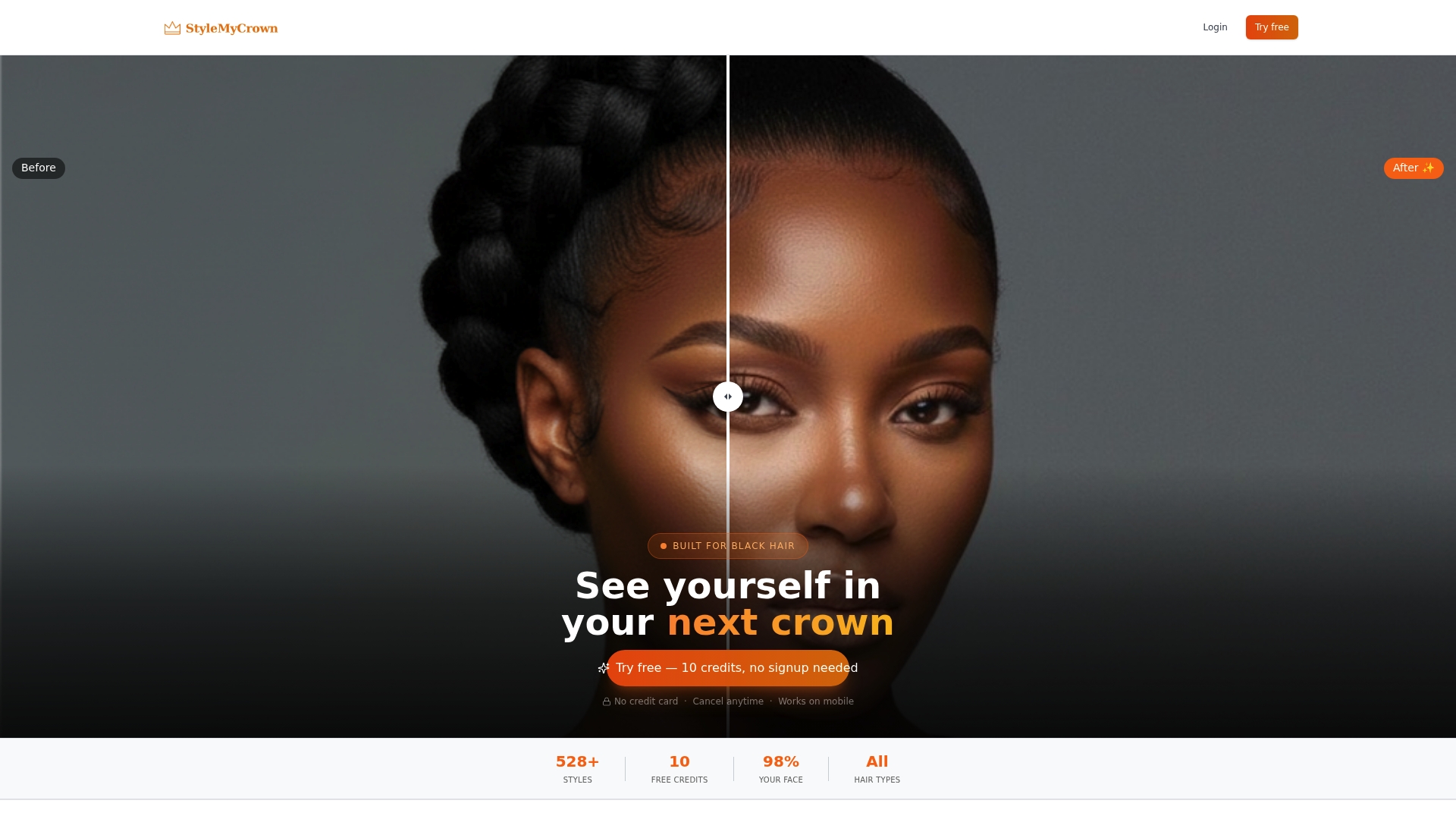
If you want to keep going, the 4 Week Plan is $38.73 per 4 weeks, and the 1 Week Trial is $0 per week. You can also browse the style catalog first, or start your first virtual try-on. Stylists can look at the stylist catalog to show clients options and cut down consultation time.
Which style should you pick?
Match the style to your situation:
- Thin or sensitive edges: two-strand twists or flat twists on your own hair, kept a bit looser at the hairline.
- Short hair or a big chop journey: wash-and-go, twist-out or flexi rod set. They need no added hair and little hold.
- Need a week-long look with little styling: Bantu knots, loose twists or a soft low bun.
- Want a braided look: light knotless braids, short and small, with a soft front.
- Need a break from everything: a wig over a loose braided base, removable at night.
Whatever you choose, the rule is the same. If it hurts, it is wrong.
FAQ
What is the best no tension style for thin edges?
Two-strand twists or flat twists done with only your own hair are a strong place to start. Keep the twists around the hairline larger and looser than the rest. Avoid adding extensions and keep the style in for a shorter stretch.
Are knotless braids really low tension?
They can be gentler than traditional braids because the hair is fed in gradually, which gives a flatter start at the scalp. They still add weight, so ask for smaller, lighter braids with a soft hairline. If you feel stinging or throbbing, tell your stylist right away.
How long can I leave a low tension style in?
It depends on the style. Cosmopolitan gives 4 to 12 weeks for braids and twists, 2 to 8 weeks for cornrows and 1 to 2 weeks for Bantu knots, and advises breaks between restyles. If your edges are thin, stay at the short end of those ranges.
How do I know a style is hurting my edges?
Pain, stinging, bumps, throbbing, headaches or a visibly pulled scalp are all signs of too much tension. Loosen or remove the style. If thinning or sore spots linger afterward, see a board-certified dermatologist.
Can I see a style on myself before I book?
Yes. StyleMyCrown lets you preview more than 528 styles on your own photo, with two complimentary credits to start, so you can decide on length, shape and fullness before you sit down.
Sources
- Essence: Low-Tension Styles for Healthy Textured Hair
- Essence: Best End-of-Summer Protective Styles and Tips
- Mayo and Callender, The art of prevention: It’s too tight, PubMed Central
- Curl Centric: Low Tension Protective Styles
- Fulham Scalp and Hair Clinic: Protective Styling for Afro-Textured Hair
- The Zoë Report: Top Textured Hair Trends for 2026
- Allure: Your Complete Guide to Protective Styles
- Keyoma Health: Sore Scalp After a Protective Style
- MIELLE: Best Hairstyles for Thin Edges
- PS Beauty: How to Maintain Cornrows
- Cosmopolitan UK: A guide to protective styles
- MadameNoire: Low-Maintenance Hair Style Ideas
- MJM Salon & Co.: Braids and Twists
- Flourish Curls: Services
- Best Practices for Hair Care and Styling in Patients with Alopecia
- RevAir: Scalp Care Under Braids, Twists, and Installs


